Technical News – The Evolution of OPS (Onshore Power Supply) Technology
An article by Raúl Villa Caro, PhD in Naval and Ocean Engineering, retired Navy officer, Merchant Navy captain, and Secretary of the Fundación EXPONAV
Electricity is essential for the operation of ships while in port, making the technologies that provide onboard power increasingly important. A berthed vessel is, on a smaller scale, comparable to a power generation plant supplying electricity to a city. During a vessel's stay in port, auxiliary engines are typically used to generate the electrical power required to meet onboard demand.
OPS
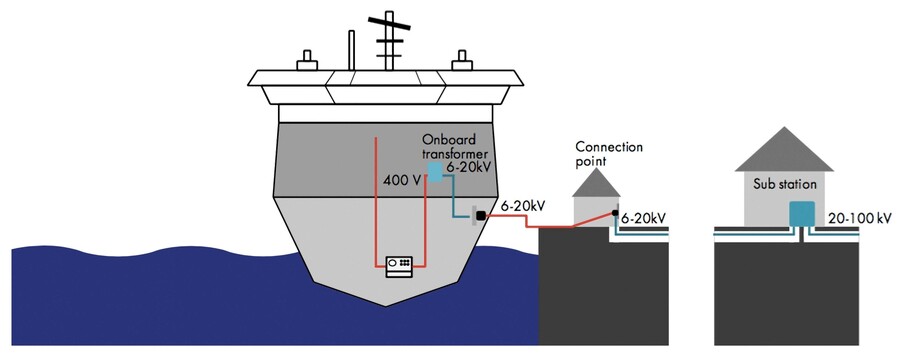
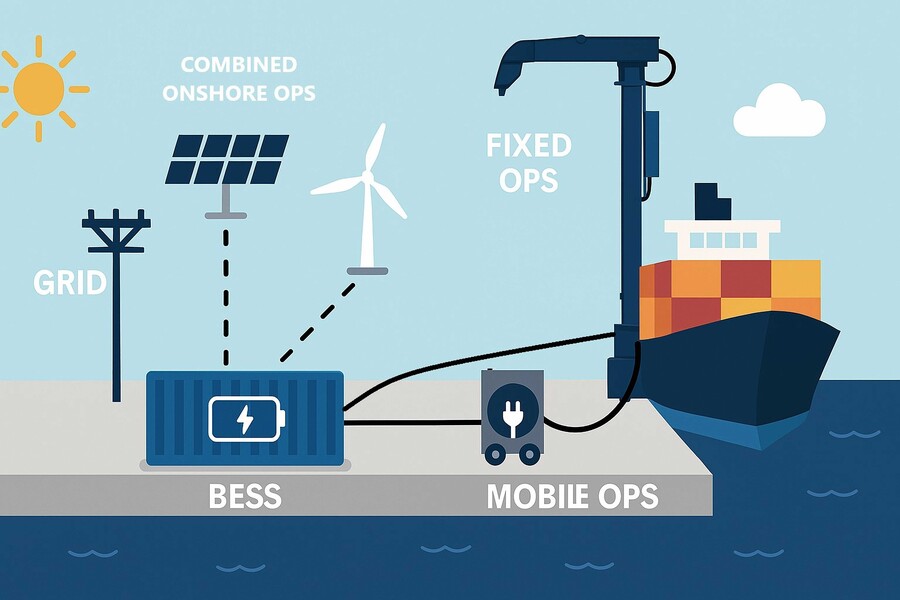
OPS (Onshore Power Supply) is a technology that enables a vessel berthed in port to connect to the onshore electrical grid or to another external power generation system. This connection allows ships to switch off their generators and auxiliary engines while alongside, meeting their electrical needs through the port's power infrastructure. As a result, noise levels and pollutant emissions are significantly reduced, while the electricity required by the vessel can be supplied through clean energy systems installed within the port. These systems may consist of modular containerised units, wind turbines or, more commonly, direct connections to the port's electrical grid.
In this context, the integration of Battery Energy Storage Systems (BESS) onboard is emerging as a promising solution for enhancing ships' energy self-sufficiency and achieving a more effective reduction in emissions.
Containerised Solutions (Mobile OPS)
The Galician technology innovation company Head Up Services has developed an advanced mobile self-sufficient power supply solution, representing a significant milestone in the transition towards a more resilient, sustainable and operationally efficient energy model. The system integrates Battery Energy Storage System (BESS) technology into an intelligent, mobile platform designed to address power supply limitations wherever the conventional electrical grid is unavailable or constrained.
One of the solution's key innovations lies in its application within port and maritime environments, where the challenges of decarbonisation and the digitalisation of maritime operations continue to grow.
Unlike traditional fixed installations, mobile OPS solutions offer complete operational flexibility. They can be deployed wherever required and enable energy to be transferred between different areas of the port, optimising energy use while avoiding costly infrastructure oversizing. This technology eliminates the need to permanently electrify every berth and provides greater versatility to supply power to other port facilities as required.
Conclusions
Energy self-sufficiency is not simply about electrification. It requires the development of an integrated energy architecture capable of managing energy efficiently and intelligently between the vessel, the port and the electrical grid.
An article by Raúl Villa Caro, PhD in Naval and Ocean Engineering, retired Navy officer, Merchant Navy captain, and Secretary of the Fundación EXPONAV