

Technical News – Classification Societies (CS) and Military Ships
An article by Raúl Villa Caro, PhD in Naval and Ocean Engineering, retired Navy officer, Merchant Navy captain, and Secretary of the Fundación EXPONAV
Throughout history, the navies of different countries have been responsible for the design, construction, maintenance, and operation of their ships. However, over the last three decades this concept has changed with the emergence of the classification of military vessels. The involvement of Classification Societies in the pre-contract stages of shipbuilding has contributed to improving the final product.
Classification Societies and Military Ships
The missions carried out by military ships define the capabilities sought in their design. What is a business objective in a merchant ship becomes the mission in a warship.
The conventions supervised by the International Maritime Organization (IMO), such as SOLAS, MARPOL, etc., exempt warships from compliance. However, this does not mean that navies do not work to ensure the safety of their ships, their crews, and the environment (the concept of “safety”). Therefore, the safety of a military vessel is not left solely to the criteria of each state. The cooperation initiated between Classification Societies and NATO in the first decade of this century led to the creation of a code: the “Naval Ship Code (NSC)”.
Regulations for Military Ships
Regulations for warships cover the same aspects as those for civilian vessels, but with certain specific features. In general, they include rules on general arrangement and compartmentation, structural strength, intact and damage stability, machinery installations, equipment and services, fire protection, abandonment procedures, and replenishment at sea.
Examples of Classified Military Ships in Spain
The Spanish Navy, in its most recent major programs—BPE (Strategic Projection Ship), BAM (Maritime Action Vessel), and BAC (Combat Supply Ship)—opted for the use of Classification Societies for the first time, a decision that has continued with the current F-110 frigate program.
In 2008, Lloyd’s Register was awarded technical support for the Inspection of Constructions in Cádiz (ICODIZ) for the outfitting and testing of the BAC Cantabria. It became the first ship in the Spanish Navy to be classified as a “Green Ship.” Lloyd’s Register had previously supported ICOFER (Ferrol) in the BPE Juan Carlos I program, although that vessel did not obtain a class certificate.
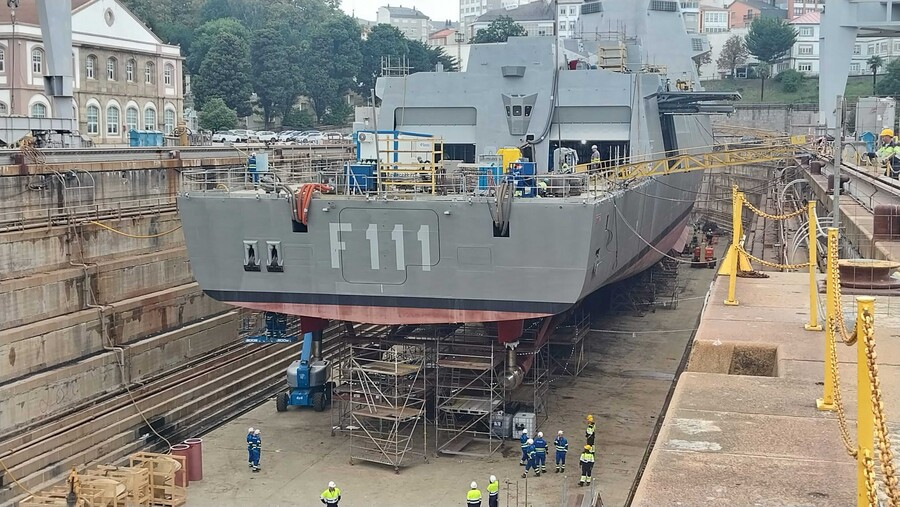
The current program for the new F-110 frigates, being built in Ferrol, includes classification under the rules of Bureau Veritas. This society was also selected for the BAM program built in Cádiz and Ferrol.
Case of Vigo
Regarding smaller vessels, the Vigo-based shipyard Freire Shipyard launched on April 13 (with delivery to the Navy expected by the end of the year) the new Diver Support Vessel (EAB), Proserpina. This state-of-the-art vessel, part of the Navy’s process of modernizing and replacing auxiliary units, aims to strengthen its underwater intervention capabilities. This ship is being classified by Lloyd’s Register.
Raúl Villa Caro, PhD in Naval and Ocean Engineering, retired Navy officer, Merchant Navy captain, and Secretary of the Fundación EXPONAV