

The collaboration between Isover and Oliver Design on Balearia’s triple fast ferries: innovation in thermal comfort, energy efficiency and naval passive fire protection
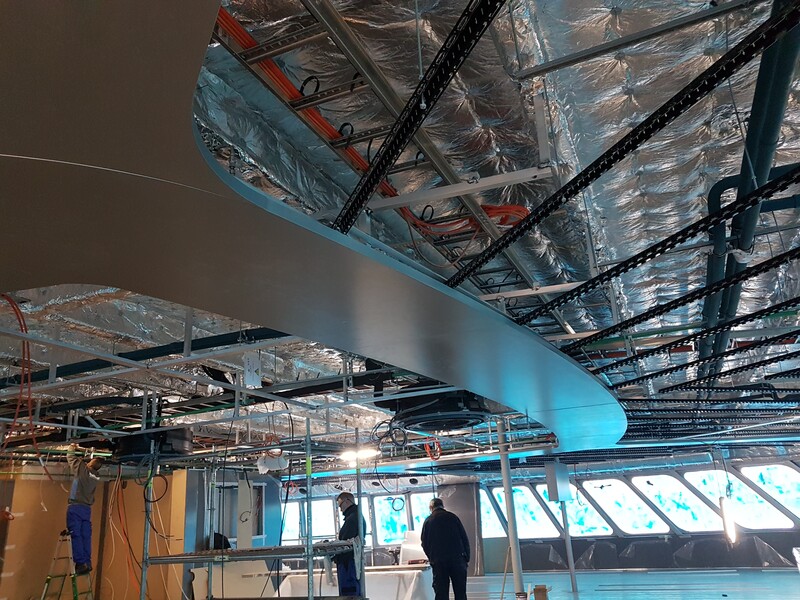
On Balearia’s triple fast ferries —Eleanor Roosevelt, Margarita Salas and Mercedes Pinto— the interior design developed and executed by Oliver Design incorporates advanced thermal insulation and passive fire protection solutions from Saint-Gobain Isover, as part of a comprehensive efficiency and sustainability strategy.
The new generation of Balearia fast ferries —Eleanor Roosevelt, Margarita Salas and Mercedes Pinto— stands as a clear example of how advanced naval design and the technical selection of materials directly influence energy efficiency, operational sustainability and onboard comfort. Designed by Oliver Design, these three sister ships share a common technological platform, developed to meet the demands of high-speed navigation while reducing emissions and optimizing energy consumption throughout their service life.
Eleanor Roosevelt, the world’s first fast ferry powered by liquefied natural gas (LNG), marked a milestone in passenger maritime transport. With capacity for up to 1,200 passengers, it integrates smart ship technologies that enable real-time monitoring of energy consumption, operational efficiency and emissions. The use of LNG allows for approximately 30% reduction in CO₂ emissions and 85% reduction in NOx emissions compared to conventional ferries, an approach that has been maintained and further optimized in its sister vessels Margarita Salas and Mercedes Pinto. Beyond the propulsion system, the thermal performance of the building envelope and interior spaces is a key factor in the overall energy balance of a high-speed ferry, as HVAC systems represent a significant share of operational energy consumption.
In this context, Oliver Design selected Saint-Gobain Isover as its technological partner to develop insulation solutions aimed at enhancing passenger comfort while improving the vessel’s energy efficiency. The main technical challenge was to achieve high thermal insulation levels within aluminium structures, under very strict requirements for low weight and reduced thickness, inherent to high-speed ferries.
To address this challenge, Isover’s technical team carried out a dedicated study based on advanced three-dimensional heat transfer calculations, taking into account real operating conditions and interior comfort requirements. The implemented solution combines two layers of mineral insulation —U SeaProtect Roll 13 Alu1 and SeaComfort 18 Alu1— which, with a total thickness of just 80 mm, achieve a thermal transmittance of approximately 0.52 W/m²·K and an overall weight of around 1.24 kg/m². This configuration significantly reduces thermal losses in winter and heat gains in summer, lowering HVAC loads and the associated energy consumption required to maintain onboard comfort.
From an operational standpoint, this optimized insulation design helps reduce the installed power requirements of HVAC systems, limit peak electrical demand and improve the thermal stability of interior spaces, complementing the efficiency gains provided by LNG propulsion.
In addition to thermal insulation, passive fire protection has been another fundamental pillar of the vessel design. All three ferries incorporate A 60 fire protection solutions specifically developed for aluminium structures. Isover contributed with its ULTIMATE® SeaProtect range, including the USP Slab 66 product for the protection of aluminium bulkheads. This mineral wool solution combines non-combustibility, dimensional stability under fire conditions and low weight, fully complying with IMO regulations and certified for use on high-speed craft.
Each vessel incorporates more than 7,000 m² of Isover insulation solutions, alongside passive fire protection systems, reinforcing the role of insulation as a key element in the project’s global strategy for energy efficiency, safety and sustainability. This integrated approach, developed in close collaboration with Oliver Design, has been replicated across the sister ships Margarita Salas and Mercedes Pinto.