

Vigo wins back its position as leading private shipbuilder industry with 22 vessels in its order book and focusing on "challenging" ships
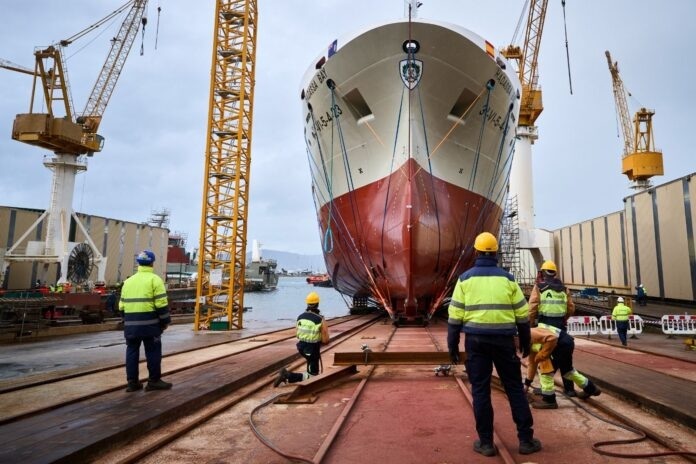
The combined workload stands at 138,000 CGT, a level that reflects the shipyards good health and, above all, the network of auxiliary companies transforming each contract into jobs, engineering, metal, and expertise.
Vigo Bay continues to maintain its pulse with the rhythm of shipbuilding. After years of ups and downs, 2025 is closing with a resounding message: Vigo has consolidated its position as the largest private shipyard in Spain, with 22 vessels on order and 45% of the private sector's workload concentrated in its slipways. The picture is not just one of volume, but of industrial profile: its strength lies in the specialization and complexity of the projects.
On Beiramar Avenue, where steel is part of the landscape, the activity is also measured in CGT—the indicator that weighs working hours, materials, and technical difficulty. The combined workload stands at 138,000 CGT, a level reflecting the robust health of the shipyards and, above all, the network of auxiliary companies that transforms each contract into jobs, engineering, metal, and expertise.
The key: competing abroad with high-value niches. Vigo's leap forward isn't explained by manufacturing "more," but by manufacturing "better" and "more complex" vessels. The sector insists on the same idea: there is a critical mass capable of competing in international markets with ships where engineering is as important as the hull. Oceanographic vessels, state-of-the-art fishing vessels, patrol boats, Mega yachts, or offshore wind support vessels: contracts that demand precision, certifications, systems integration, and a finely tuned supply chain.
The order book is also globally opened. Orders span a long list of flags and destinations, and the client portfolio consolidates a trend that the Galician shipbuilding industry has been cultivating exporting and specialization as a formula for protecting itself against economic cycles.
Freire, Armón–Ría de Vigo, and Cardama: Three Profiles, One Bay
Freire Shipyard stands out in this momentum, with a portfolio encompassing science, the primary sector, and the high-end luxury segment. The shipyard is working on oceanographic vessels such as Anita Conti (France), Thuwal II (Saudi Arabia), and Dana V (Denmark), and is also maintaining media attention on a confidential, large-scale project—a 107-meter Mega yacht known as “Incognita”—which is poised to become one of the most talked-about milestones of the coming year.
In parallel, Vigo Bay has placed itself on the radar of the energy transition. Astilleros Ría de Vigo (Grupo Armón) is pursuing a particularly symbolic contract: the service vessel for offshore wind farms for Bibby Marine, designed to operate with batteries and low-emission systems, with a design that even includes recharging at sea. It's the kind of project that not only adds workload but also positions the shipyard—and the local ecosystem—in a market that Europe wants to accelerate.
And at the other end of the portfolio, Cardama maintains activity with defence and multipurpose orders, although one of its most high-profile contracts, the ocean patrol vessels for Uruguay, has been surrounded by political and administrative controversy in the purchasing country, adding noise and uncertainty to a segment where reputation is almost as valuable as delivery time.
2026: More workload… and the major bottleneck
The immediate outlook is one of continuity. Aclunaga Maritime Cluster projects a 10% increase in projects under construction by 2026 and speaks of near-record growth. But the sector itself points to the main limitation: labour. The warning is clear: a significant portion of the workforce will retire in less than a decade, and if the replacement process—training, recruitment, and specialization—isn't accelerated, the Vigo estuary risks having orders… without enough skilled labour to complete them on time.
In short, Vigo isn't leading solely in terms of numbers. It leads in the type of contracts it's securing and its ability to turn complexity into a competitive advantage. The challenge now is to maintain this pace: securing staff, maintaining quality, and continuing to win market share in a world demanding cleaner, smarter, and more complex ships.
Source: Europa Azul