

Cruise ship orders boost ensures work for European shipyards until 2036
Fincantieri, Meyer, and Chantiers de l’Atlantique have secured contracts with deliveries scheduled between 2030 and 2036, an unusual timeframe after years of stagnation.
The global cruise market, which just four years ago was characterized by caution and delays, is now experiencing what analysts are already calling a “remarkable turnaround.” The global order book currently includes 74 large cruise ships under construction or on firm order, in addition to expedition and river vessels. Most importantly, the bulk of these contracts are for deliveries starting in 2030. This means that the three major European cruise ship manufacturers—Fincantieri, Meyer (Germany/Finland), and Chantiers de l’Atlantique (France)—are once again operating with the visibility they enjoyed for almost a decade before the pandemic.
The best example illustrating this shift is the mega-contract Fincantieri signed with Norwegian Cruise Line Holdings: four megaships of approximately 226,000 GT each, with over 8,000 passengers on board and staggered deliveries in 2030, 2032, 2034, and 2036, valued at around €9 billion. For a shipyard, having such a delivery schedule means loading its supply chain, securing subcontractors, and setting prices years in advance.
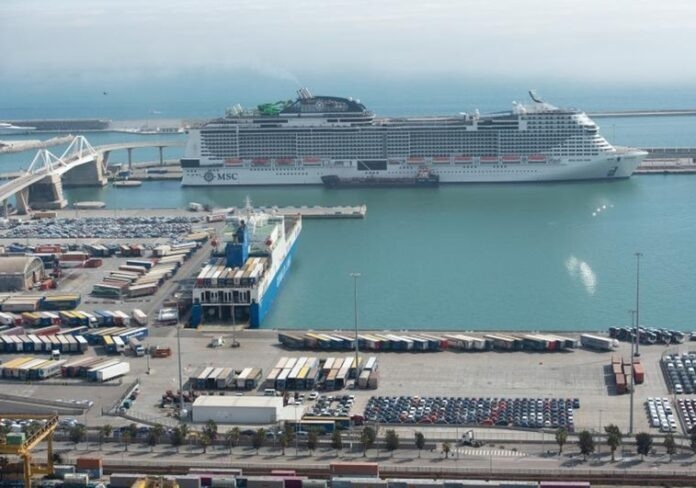
France is not lagging behind. Chantiers de l’Atlantique has renewed its partnership with MSC for two new World Class ships—the fifth and sixth in the series—with deliveries scheduled for 2029 and 2030. These ships will be equipped with state-of-the-art LNG engines and systems prepared to use green methanol and synthetic methane. This is the first time this French shipyard has so clearly stated the hull will be "future fuel ready."
Meyer, for its part, has made a reality of something it had been announcing for years: the "Mein Schiff 7," built in Turku for TUI Cruises and launched as methanol-ready, demonstrates that large cruise ships can now leave the shipyard with piping, tanks, ventilation, and safety systems designed to operate on e-methanol when the fuel becomes available on a large scale. "Nearly climate neutral" is the goal the German company has set for its new cruise concepts.
Why is it so important that they are "methanol ready"? Being prepared for alternative fuels is no small feat. It means more weight, more tank space, more wiring, more automation, more sensors, and, in many cases, redesigning hotel spaces to avoid losing passenger capacity. Meyer explained it clearly: to absorb the increased operating costs of e-methanol, more cabins and amenities must be packed into the same hull, requiring a more sophisticated design.
Along the same lines, Fincantieri, Eni, and RINA published a study in 2025 on the fuel mix of the future, which is pushing shipowners to request "convertible" vessels capable of switching from LNG to methanol, advanced biodiesel, or even fuel cell modules on deck. Each of these options requires more hours of naval engineering and systems integration, and that is precisely what shipyards are now appreciating: each cruise ship is becoming less like an industrial production run and more like a high-engineering project.
The 2030-2036 Phase: A Buffer Not Seen Since Before 2020
Analysts following the sector emphasize that the staggered delivery schedule through 2036 shown in the charts from Riviera Maritime and Cruise Industry News signifies two things: first, that shipping companies have regained confidence in demand—following a period of rising bookings in 2024-2025—and second, that Europe maintains its monopoly on large cruise ships against Asia. “The rebound has hit hard in 2024 and 2025,” noted Maritime Strategies International.
The September 2025 snapshot from the World Orderbook confirms this: of the large cruise ships on order, 37 are in the hands of Fincantieri, 9 of Meyer, and 9 of Chantiers, a distribution that reinforces the shipyards in Monfalcone, Marghera, Turku, Papenburg, and Saint-Nazaire as strategic industrial hubs for the EU.
Ripple Effect on the European Supply Chain
The European cruise industry association points out that 80% of the value of European shipyards' commercial order books comes from the cruise segment. This means that thousands of SMEs specializing in interiors, HVAC, wiring, gangways, energy-saving solutions, and hotel software benefit when the market shifts from 3–4-year delivery lead times to 8-10 years. Each large ship represents thousands of direct and indirect jobs for two or three years.
Furthermore, given that these ships face increasingly stringent environmental requirements—FuelEU Maritime, the European ETS, and IMO targets for 2050—shipowners prefer to order hulls now that can be retrofitted later rather than wait for a winning fuel. This is where European shipyards, which have been investing for a decade in fuel cell integration, hybrid propulsion, and 1,000V networks, have an advantage over Asian competitors.
Source: Europa Azul