

Spanish Maritime Cluster calls on the Congress of Deputies to establish a Spanish Blue Economy Strategy
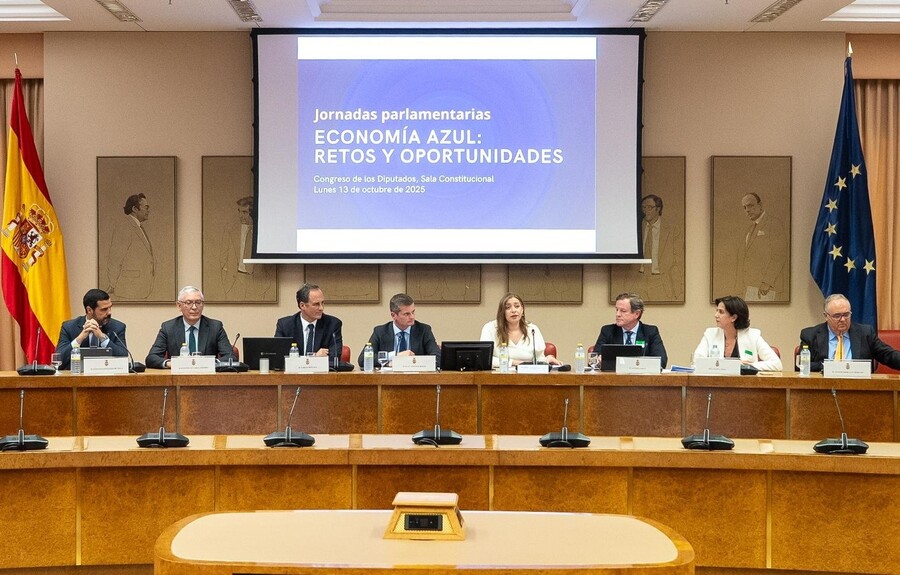
Javier Garat presents ‘España en Azul’ Manifesto and proposes its recognition as a strategic sector to boost employment, sustainability, and competitiveness
Spanish Maritime Cluster (CME), led by its president Javier Garat, presented España en Azul’ (Manifesto for a Spanish Blue Economy Strategy) this week in the Congress of Deputies, during “Blue Economy: Challenges and Opportunities” parliamentary conference. The event, organised by the Popular Parliamentary Group, served as a platform to call for the official recognition of the blue economy as a strategic national sector, as well as to propose urgent measures in policy coordination, talent attraction and sustainability.
Mr Garat took part in the first round-table discussion of the meeting, which focused on the maritime-port industry. Moderated by Tenerife MP Juan Antonio Rojas, it featured key representatives from the sector, including Elena Seco (ANAVE), Gustavo González de Vega (Canary Islands Government), Carlos Botana (Vigo Port Authority), Ignacio Álvarez-Ossorio (Andalusia Ports Agency) and Antoni Mercant (Balearic Government).
In his speech, CME president emphasised the economic and social importance of Spanish blue economy, highlighting its diversity and its impact on areas such as logistics, fishing, maritime tourism, innovation and energy transition, among others. “It is time to recognise blue economy for what it is: a strategic sector for Spain, reaffirming its key role in industrial and food sovereignty, ecological transition and international competitiveness,” he said.
One of the central axes of the manifesto is the need to develop a Spanish Blue Economy Strategy. Mr Garat regret the current fragmentation of responsibilities, with at least eleven ministries involved, which hinders effective governance.
The manifesto also addresses one of the greatest challenges facing sector’s future: generational renewal. Mr Garat warned maritime industry is not attracting enough young talent, which puts its sustainability at risk. He, therefore, called for the strengthening of specialised training, vocational guidance and career opportunities visibility. “Blue economy offers opportunities for technical profiles such as welders and naval engineers, but also in emerging areas such as digitalisation, sustainability and innovation,” he stressed.
In addition, the document includes other key measures to consolidate the sector:
- Promoting public–private investment and collaboration between agents, particularly at regional level.
- Improving the collection of sectoral data.
- Fostering a maritime culture among citizens.
- Promoting R&D&I and digitalisation.
- Encouraging internationalisation and regulatory simplification, reducing bureaucracy.
The event was described by Popular Party spokesperson Ester Muñoz as an exercise in “active listening” to civil society, stating “this is not a political event organised by the Popular Party, but rather a meeting where MPs actively listen.” The event concluded with a second round-table discussion focusing on fishing, tourism and innovation, featuring prominent figures such as Rosa Quintana, the Popular Party’s spokesperson for fisheries in the Congress of Deputies; Gabriel Mato, MEP and coordinator of the PPE Group’s Committee on Fisheries; Julio Morón, president of the Spanish Fishing Confederation; Mercedes Pardo, president of the Blue Education Association; Juan Virgilio Márquez, director general of the Wind Energy Association; Tomás Azcárate, president of the Spanish Federation of Marinas and Tourist Ports Associations; and José Francisco Fernández Aparicio, secretary general of the PYMAR Council.
During the meeting, a debate arose about the convenience of creating a “Ministry of the Sea” or, at the very least, an economic vice-presidency that would centralise efforts and promote a unified vision among other ministries with blue economy responsibilities.
With this manifesto, the Spanish Maritime Cluster — of which Navalia is a member and which represents more than 150 entities and over 3,000 companies — reaffirms its role as a key interlocutor between the sector and institutions and calls for blue economy to be placed at the heart of Spain’s strategy, urging it be treated as a political priority.