

Freire is building the fishing vessel of the future
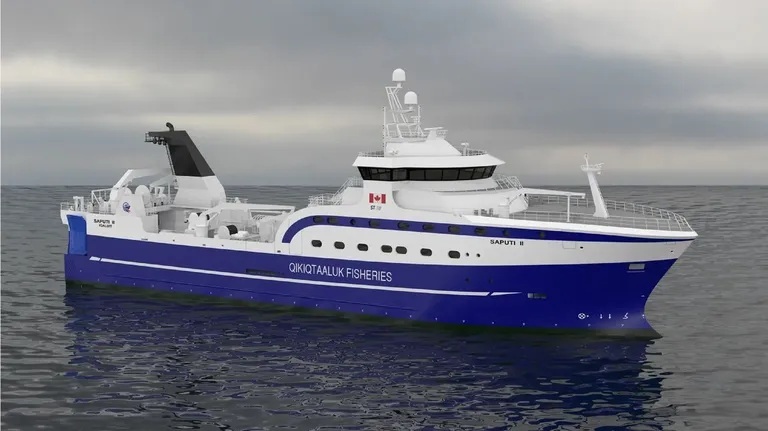
Saputi II, for an Eskimo corporation, will alternate shrimp and halibut harvesting and will feature automated freezing and palletizing processes.
When new winds of technology and cutting-edge building have blown, Vigo’s Freire Shipyard has known how to take this path. In recent years, some of the most unique orders for Galician shipbuilding industry have come from its docks, such as Falkor (Too) and Renaissance mega yacht. They are now working on the development of a freezer trawler for the Arctic. This is a significant order for Eskimo corporation's Qikiqtaaluk fishery and incorporates important advances: it will be equipped with a processing plant alternating between two species, shrimp and halibut, and onboard freezing processes will be automated.
"It's a great project," as Jerry Ward, company's fishing director, defined it. It's called Saputi II. It is designed to maximize crew's work shifts profitability, all of them from Inuit origin. Name given to Arctic regions communities. The ship that will shape Galician shipbuilding industry will be Canadian, and it will have capacity for thirty people on board.
Two weeks ago, Vigo’s shipyard announced the main engine installation for this "state-of-the-art" fishing vessel, as they described it. It is a Wärtsilä system, efficient and low emission, designed to "optimize the use of their catches," according to its owners in a statement. The vessel measures 79 meters in length and 17 meters in width, and the hull, being assembled at Freire Shipyard, must be capable to navigate and fish on the ice pack. The vessel will operate in frozen waters between Greenland and Canada.
Soon, the slipways on Beiramar Avenue will carry out work to equip Saputi II's innovative processing plants. The shipowner has entrusted Danish company Carsoe with the manufacture of two production lines so that the vessel can alternate between different species depending on the fertility of the sea. The order will have the capacity to process 750 tons of shrimp and 1,100 tons of halibut.
Another advance is the lack of manual labour in the onboard freezing processes, as they will be "fully automated" and equipped with robots, as indicated by the shipowner. The palletizing process will also be improved. This will result in an increased production and improved working conditions for the crew. It also improves product freshness.
Robotic machinery will also oversee the final packaging section of this marine factory, handling product sorting, palletizing, and transporting it to cargo hold.
The shipyard celebrated the keel laying of the innovative fishing vessel in September last year, and construction is expected to be completed between the end of this year and early 2026. With its delivery, the Canadian shipowner will improve its capabilities compared to Saputi.
(Source: La Voz de Galicia)