

Alberto Ruiz announces in Navalia that Spanish Ministry is working on a National Industry Strategy
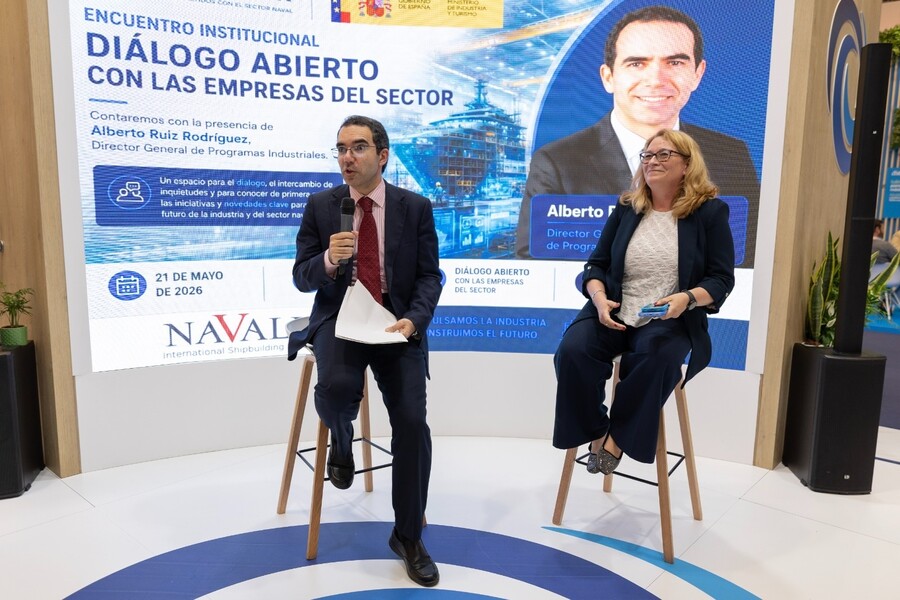
The Director General of Industrial Programs at the Ministry of Industry and Tourism participated in an open dialogue at the SOERMAR stand at the trade fair, where he explained that the objective is to strengthen competitiveness, strategic autonomy, and the adaptation of the productive sector to the dual ecological and digital transitions.
The Director General of Industrial Programs at the Ministry of Industry and Tourism, Alberto Ruiz Rodríguez, announced during an open dialogue at the SOERMAR stand at Navalia that Spanish Government is working on a National Industry Strategy with the objective of strengthening competitiveness, strategic autonomy, and the adaptation of the productive sector to the dual ecological and digital transitions.
During his conversation with the companies, Ruiz highlighted the need to update the industrial regulatory framework, in effect since 1992, through the draft Law on Industry and Strategic Autonomy, currently under parliamentary review. “We want a more modern framework, with greater dialogue with the industrial sectors and measures more closely aligned with their real needs,” he stated. In this context, he explained that the Ministry has already launched dialogue mechanisms such as the High-Level Industry Forum, which recently held its first meeting and aims to strengthen the participation of the business sector in the design of industrial policies, including key areas such as digitalization.
Ruiz took the opportunity to review the main support mechanisms for the shipbuilding sector, such as traditional financing lines, as well as the recent boost supported by the PERTE programs, which have fostered collaboration between large companies and SMEs throughout the value chain.
He also commented that, although these programs linked to European funds have a limited duration, the Ministry is already working on redesigning instruments to ensure the continuity of strategic projects that have been left without funding, especially those considered to be of national interest or key to the sector.
He also emphasized the Ministry of Industry “has staunchly advocated for giving shipbuilding a voice, because the maritime industry is not exclusively maritime transport; it also includes shipbuilding, and we have wanted this distinction to be reflected in the strategies.”
At the European level, Ruiz highlighted Spain's role in promoting the EU Maritime Industrial Strategy, stressing the need to strengthen cooperation among member states and to give greater visibility to shipbuilding within the maritime ecosystem. “The goal is to strengthen European competitiveness against international competition and advance collaborative projects that involve the entire value chain,” he explained.
Dual-use technologies and new opportunities
The Director General also referred to the growing role of dual-use technologies—with both civilian and defense applications—as an opportunity for the shipbuilding sector. In this regard, he mentioned the launch of a program aimed at facilitating the entry of companies into the defense sector through training, innovation, and participation in technological challenges. Along these lines, he encouraged companies to strengthen their collaboration with the Ministry of Defense and with leading companies in order to capitalize on the opportunities arising from increased defense investment at the European level.
Finally, Ruiz emphasized the importance of strengthening coordination between the Ministry of Industry and other ministries such as the Ministry of Transport, especially in areas like new fuels and the decarbonization of maritime transport. These elements, along with attracting industrial investment and developing new production ecosystems, will form part of the future National Industry Strategy that the Government is currently developing.