

Mercy Ships highlights volunteering as the driving force behind its hospital ships at Navalia.
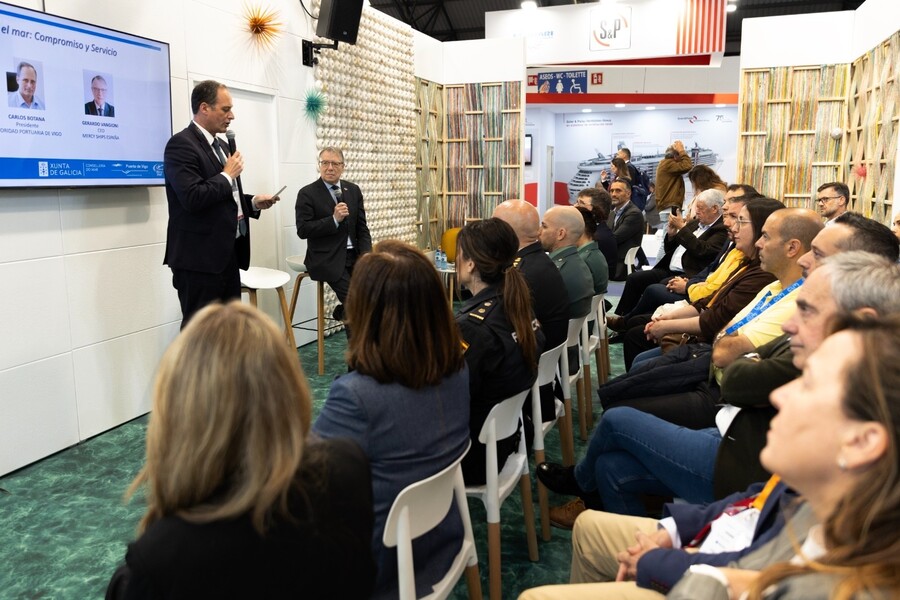
Mercy Ships presented its humanitarian work today at Navalia, showcasing the mission it has carried out for more than four decades through its hospital ships during a conference titled “Volunteering at Sea: Commitment and Service.” The session featured Gerardo Vangioni, the organization’s representative in Spain, and Carlos Botana Lagarón, president of the Port Authority of Vigo.
During the event, held as part of the international naval industry fair, Mercy Ships highlighted a reality that continues to affect millions of people worldwide: the lack of access to safe, affordable, and timely surgery. According to figures shared by the organization, around 5 billion people worldwide do not have access to this type of surgical care, and every two seconds someone dies because they are unable to receive the operation they need.
“We are fortunate. In Spain, we have a public healthcare system, hospitals, professionals, and resources. But there are millions of people in the world who have no ambulances, no hospitals, and no medical professionals. Either they have money, or they are condemned to suffer or die because they do not have access to the healthcare they need,” explained Gerardo Vangioni during his speech.
The organization focuses its work in Africa, where it has carried out much of its activity over the past 37 years. Its model is based on hospital ships that bring specialized medical care to countries that invite the organization to collaborate, while also training local healthcare professionals and supporting healthcare infrastructure and sustainable development projects.
“Why do we use ships? Because ships give us mobility and allow us to reach people who lack the most basic necessity in life: access to healthcare,” said Vangioni. “We do not only want to respond to surgical needs, but also to train and empower local healthcare professionals, and to use the ship as a platform for healthcare infrastructure and sustainable development projects,” he added.
Mercy Ships currently operates the Global Mercy, the world’s largest civilian hospital ship, and the Africa Mercy. On board are operating theatres, recovery wards, training facilities, community living areas, and all the services required to sustain a small floating city. The Global Mercy alone features more than 7,000 square metres of hospital space, six operating rooms, capacity for 200 patients, and a community of hundreds of volunteers.
The conference also highlighted the essential role of ports and the maritime community in Mercy Ships’ mission. The hospital ships require maintenance, repairs, provisioning, logistical support, and technical services before beginning their humanitarian campaigns, work in which Spanish ports have played a key role over recent decades.
“Since 1991, Spanish ports have been essential in helping us maintain and repair our ships and provide the supplies that allow us to travel to Africa and carry out our humanitarian work,” Vangioni stressed. “Without the support of Spanish ports, we would not be able to do this. In that regard, Vigo is an example of solidarity, support, and professionals serving humanitarian causes,” he said.
Since 1978, Mercy Ships has carried out more than 125,000 life-changing surgeries, provided over 570,000 dental treatments, trained more than 57,000 healthcare professionals, and supported more than 1,115 healthcare infrastructure and development projects. The organization operates through private funding, including donations from individuals, institutions, foundations, and companies, as well as in-kind contributions and services.
“We need more volunteers”
One of the main themes of the presentation was volunteering. Mercy Ships is supported by an international community of professionals from a wide range of backgrounds, including healthcare workers, sailors, officers, engineers, cooks, teachers, administrators, logistics specialists, security staff, procurement professionals, and human resources personnel. In 2025, the organization reached 3,200 volunteers from 71 countries.
“We need more volunteers. It is people who make it possible for us to bring hope and healthcare,” explained Vangioni. “We are not only looking for surgeons, nurses, or anaesthetists. We also need captains, officers, sailors, engineers, cooks, administrative staff, logistics professionals, procurement specialists, security personnel, and human resources experts. All of these roles are essential for a hospital ship to operate,” he added.
The presentation also included stories of patients who regained their health, independence, and future thanks to Mercy Ships’ work. Cases such as Harimalala, a young woman who arrived on board with a tumour that affected her ability to eat and breathe, helped illustrate the real impact of every surgery. “Behind every operation are people who now have a future, who now have hope, who can live and be part of society,” Vangioni recalled.
The event concluded with an overview of the organization’s next steps. The Global Mercy will continue its mission in Sierra Leone until mid-June and, after its annual maintenance, repairs, and provisioning period, will head to Ghana, where it will serve from mid-August 2026 until June 2027. Meanwhile, the Africa Mercy is currently in South Africa preparing for its next humanitarian mission in Madagascar, scheduled from May to December 2026.
Through its participation at Navalia, Mercy Ships sought to bring its mission closer to Galicia’s naval sector — a mission in which technology, logistics, maritime expertise, and human commitment come together in service of a common goal: delivering free medical care where it is needed most.